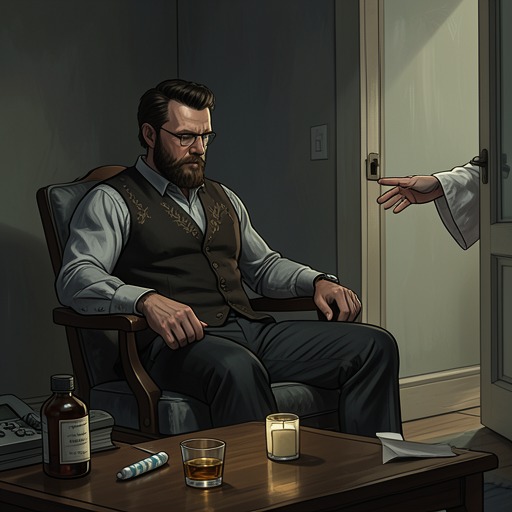
Sobriety
Stolen WanderSobriety is a fragile, repeatedly tested state in Bill O’Neill’s life, not a single declaration that erases the past. His first claim that he has stopped drinking brings Nancy O’Neill a flicker of hope, but she remembers how quickly earlier sober spells ended. Only later does Bill describe a year-long rehabilitation plan and report that he has gone eleven months without a drink. The contrast makes abstinence meaningful while leaving its durability, and the work of repairing their relationship, unresolved.
First Claims and Physical Signs
Bill’s initial request for help is practical: a leak in his kitchen requires a trip to the hardware store. Nancy assumes that he is too drunk to drive. He corrects her, saying that he is sober but too unwell to drive because of a severe headache and uncontrollable shaking. His condition makes sobriety visible not as ease or recovery, but as an uncomfortable state that still limits his ability to function safely.
Bill also uses the request to seek forgiveness. He says he wants to apologize and show Nancy that he can be a better man. She refuses to treat the declaration as proof. He has been sober before, she recalls, but never for more than a couple of days; those brief intervals have been long enough to raise her hopes before drinking resumes. She agrees to get him the tool, but distinguishes immediate practical help from trust: change will have to be demonstrated over time.
The sight of Bill waiting outside his apartment, clean-shaven and dressed neatly, nevertheless unsettles Nancy’s defenses. His hands are folded and his appearance is orderly, though they tremble when he gets into her car. She imagines him holding her child, taking the child to the park, and being present for her in a way he was not during her own childhood. The fantasies arrive against her judgment, because she knows how often hope has risen and collapsed before. His first sober spell therefore affects more than his health: it reopens the possibility of a dependable father and grandfather, while exposing Nancy to another potential disappointment.
Sobriety Does Not Undo Harm
The later disclosure of Nancy’s pregnancy reveals how little a claim of sobriety, by itself, can settle between them. When she tells Bill that Rex Foster is the father, Bill reacts with visible anger and urges her to go with him immediately, framing the child as a criminal’s baby. Nancy orders him out of the car and invokes the fear he caused her while she was growing up, as well as the pain of being allowed to hope. The scene does not establish that sobriety caused or excused his reaction; instead, it shows that abstinence and changed conduct are separate questions. Nancy’s boundary is shaped by a history that a short sober interval cannot erase.
That distinction becomes more consequential when Bill later comes to speak with Nancy. He says that he has contacted a rehabilitation facility and has been accepted into its longest program: a year, including three months without contact with the outside world. He presents the commitment as a chance to put his life in order and prove he can become a better man. He also names the harm more directly, acknowledging that Nancy was a child who did not deserve to grow up amid the misery he brought into the family. His tears make the account of his past emotionally immediate, but the program’s duration also gives his promise a concrete test beyond the brief spells Nancy remembers.
Rehabilitation and Accountability
Nancy comforts Bill, telling him he can make things right, but privately admits that she does not truly believe it. Her reassurance is an act of care, not confirmation that trust has been restored. She has never seen him break down in this way, and his visible distress complicates her response without cancelling the memories behind it. The possibility of recovery asks her to remain open to change while preserving her right to doubt it.
Rex supports Bill by arguing that a person can still find a way back after years of repeated mistakes, but that doing so requires strength and a fight against the pattern itself. Bill responds that he will fight and prove his change rather than ask Nancy to rely only on his word. In this exchange, sobriety is framed as sustained responsibility: not merely wanting forgiveness, but undertaking a demanding program and accepting that others will judge the result over time. Rex’s own reflections on escaping destructive ruts deepen the parallel, though Bill’s recovery remains his own obligation.
Evidence of Continued Abstinence
Near Nancy and Rex’s wedding, Bill calls from a manager’s phone at the rehabilitation facility. His voice sounds clearer and more alert to Nancy than she has ever heard it. He says he has not touched alcohol in eleven months, is looking into security work, and hopes to return to ordinary life as a better man. The search for work gives his report a practical dimension: he is thinking about what life after treatment might require, rather than speaking only in the language of regret.
Bill cannot attend the wedding, and he does not presume that he will automatically be welcomed back into Nancy’s life. He hopes to visit her, Rex, and the baby after leaving the facility, but first asks whether that would be acceptable. Nancy answers warmly and approves of his employment plans; she can also tell that he is hungry for her approval. Her response signals renewed possibility, not a declaration that the past has been settled. The call preserves both sides of their relationship: Bill’s effort to become reliable and Nancy’s cautious willingness to recognize it.
Meaning and Limits
The novel measures Bill’s sobriety through recurrence and duration. A few sober days once produced hope without lasting change; the later commitment extends to a year, while the report of eleven alcohol-free months provides a specific measure of progress. Physical shaking, a rehabilitation program, the admission of childhood harm, the intention to seek work, and Nancy’s guarded encouragement each mark a different part of that process. None alone proves that the damage has been repaired.
Sobriety thus becomes a condition for possible reconciliation rather than reconciliation itself. Bill’s progress matters because Nancy wants him to get better, and because his earlier drinking shaped the childhood she names when she finally refuses to be hurt again. At the wedding, his absence and his promise to visit later keep recovery open-ended: there is evidence of sustained effort, but the future relationship must still be earned.